205-956-2184
August 2026 Calendars
August 05, 2026

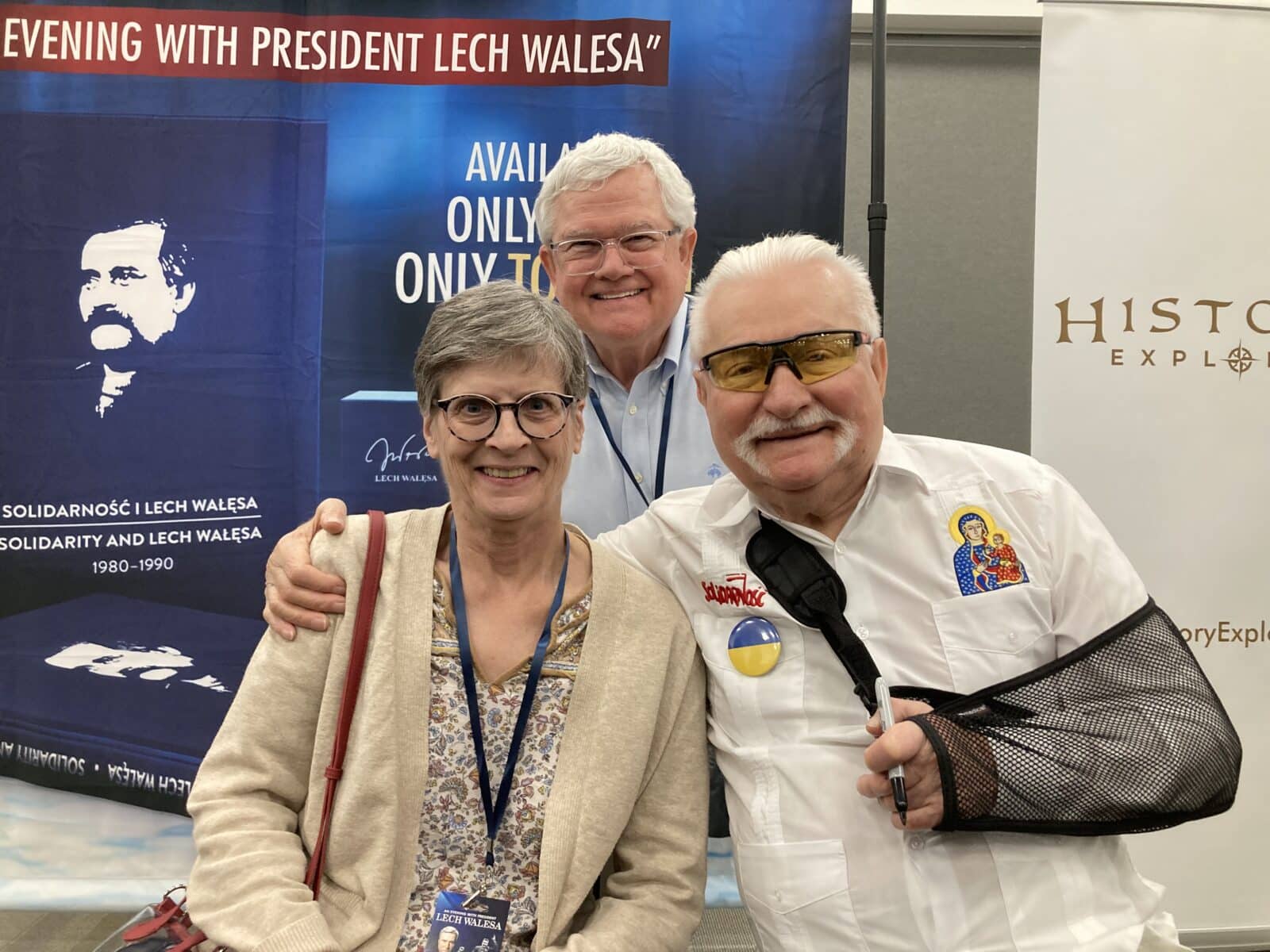
In September 2025, my wife and I drove to Atlanta to hear one of my heroes, Lech Walesa. Some of you may remember him. He was a “regular guy” working in the Gdańsk (Lenin) shipyard who rose through the ranks of his union to eventually become the President of Poland and a recipient of the Nobel Peace Prize.
When Pope John Paul II (the Polish Pope) visited Poland in the early days of the Solidarity movement, his visit added immense credibility to what Walesa was attempting to achieve. Under Walesa’s leadership, the Polish people shifted from communist rule toward democracy. That night in Atlanta, when Walesa was asked about the Pope’s visit, he said, “The Pope brought the word, and we made it flesh.”
Another of my heroes is Václav Havel, the former President of the Czech Republic. He also led a non-violent revolution, though rather than a dock worker, Havel was a poet and writer. What he orchestrated came to be known as the “Velvet Revolution.” It was defined by an absence of violence or vengeance against previous rulers; their slogan was simply, “We are not like them.” One of my treasured books is an autographed copy of his work, The Art of the Impossible. Beside the book, I keep photocopies of the speech he delivered at Macalester College in 1999. I was almost there to hear it in person—but that’s another story.
Although I have only mentioned two heroes, you may see a pattern forming. I am drawn to leaders who are ordinary, artistic, and non-violent. It is easy to see how Jesus fits this model. As believers, we don’t think of Him as ordinary, but I suspect most of the people who heard Him 2,000 years ago did. At first glance, He was an ordinary man from the country with a group of ordinary followers.
Before long, however, they realized there was more to Him—a quiet strength and a natural leadership. He had a way of making contact with folks when He spoke, a feeling that He was speaking right to your heart. His values were rooted in the immense value He placed on every human life. Truly, He was “not like them.”
We come to Easter after the season of Lenten preparation. Part of what we do during Lent is take the time to think, to remember, and to wonder. In our Christian tradition, we think about baptism as a “setting apart.” We say that the water of baptism marks us as a child of God. In an important way, we are called to be “not like them.” I don’t intend this to be exclusive, but rather to say that we are called to be different in the world.
Easter reminds us that Christ was, and is, not like them. He showed us this through His love and His acceptance of those who were different. During this Easter season, as we wonder how to follow the call of Christ, perhaps we can start by following His example of non-violence—even when we are convinced that our anger is righteous.
I pray for our Kirkwood community that Easter brings a season of new life, renewed hope, and a sense of renewed purpose.
Peace,
Cary

Our residents come from different backgrounds and bring their unique qualities, talents, and life experiences to complete the Kirkwood community. Here are just a few reflections from some individuals who call Kirkwood their home.

My time at Kirkwood was spectacular; they taught me how to walk again. The staff was outstanding, and the care was beyond reproach. When I arrived, I had a long way to go. I was very sick. The first night, they had to lift me as I could not move by myself. When I left, they were chasing me down the hallway. They taught me how to perform the activities of daily living again. It was the best care I could have prayed for, and on top of that, the food was spectacular.
I fell in love with the cottage and the view from my back porch. I am excited to have a yard for Ginger, my poodle, to play in and my own garage, all within an established retirement community!
My husband and I looked at a number of places when deciding to move to a retirement community. For the most part, we found communities that said, ‘We’re going to take care of you.’ But Kirkwood was different. It wasn’t just about taking care of us. It was also about having fun, having friends, and living life to the fullest. The attitude at Kirkwood was positive and the atmosphere was comforting. We simply couldn’t resist. Without a doubt, the location was ideal. The Cahaba Room that overlooks the river, the mountains, the trails – there were just so many things about life. The community was lively. It was alive.
We realized we were approaching an age where we might need more assistance than what just downsizing could provide. Knowing we have my sons nearby and the levels of care should we need it is comforting, and the beautiful hillside, river, and the woods makes it that much more appealing. We don’t know of any other community that has the woods, the various levels of care, and so many different amenities.
We were moving my parents down from the Cleveland area to be near us. I looked at almost every retirement place in the Birmingham area. The second I turned into Kirkwood’s drive and drove up the hill, I knew that I’d found the perfect place for my parents to live in Alabama. In the six years that my parents have been at Kirkwood, I have always felt nothing but love and helpfulness from every staff member. Everyone is always helpful with a pleasant attitude. You can truly see and feel the family atmosphere. I’m happy that my parents can call Kirkwood their home.
When we learned that Cedar Ridge was being developed, that seemed to fit our needs very well. It is the ideal place for the next phase of our retirement.
One thing that we feel is very important here at Kirkwood by the River is the relationship that we have between the staff and the residents. They are dedicated to making our life here as safe and secure and pleasurable as possible. That goes a long way.
The community's cottage living surrounded by a wooded, natural environment with access to future healthcare services is what attracted us to Kirkwood!